SKU Generator
The SKU Generator automatically creates unique SKUs for new inventory items.
You can select your SKU format in your Inventory Settings.
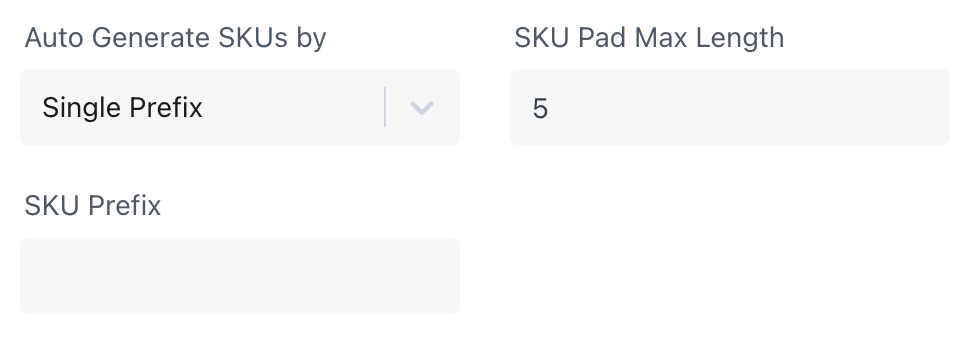
Auto Generate SKUs Options
None
Effectively turns the SKU generator off. Used when you have your own custom SKU generation scheme that doesn't work with the available options. It will use the image filename if the Use Filename as Title? Inventory Settings toggle is enabled.
Auto Incrementing Number

A positive integer that increments by 1 with each new item created, just like how order and invoice numbers auto-increment with each new order or invoice. The minimum number is 10 because SKUs must be at least two digits.
Note there are no leading zeros in this option. Use the other options for consistent SKU character lengths.
Set the Next SKU Number to the next SKU for a newly created item.
Artist Identifier
For Cleared Art Gallery clients only.
The SKU for each artist's work is prefixed with the identifier for that artist.
When typing into the inventory item's SKU field, an autosuggest dropdown will appear suggesting artist identifiers as the SKU prefix. After saving, an auto-incrementing number will be added to the prefix.
The Identifier is set in the Artist's profile form which is reachable from the Artists List.
Artist Name
For Cleared Art Gallery clients only.
The SKU for each artist's work is prefixed with the identifier for that artist.
The SKU is generated using the Artist Name set in the inventory item's Artist/Subcategory field. The artist's Identifier is used as the prefix and an auto-incrementing number is appended.
The Identifier is set in the Artist's profile form which is reachable from the Artists List.
Department
Allows unique SKU prefixes for each department.
Once a department is selected for a new item, a SKU is generated using the department prefix and an auto-incrementing number.
This requires some backend configuration by Propcart to create a mapping of the departments to their corresponding SKU prefixes.
Example: Let's say you have three departments with the following prefixes:
Furniture: FR
Cleared Art: CA
Lighting: LT
And let's say your SKU Pad Max Length is 5. Example SKUs would then be:
FR00001, FR00123, FR12345
CA00001, CA00123, CA12345
LT00001, LT00123, LT12345
Because line items are ordered by SKUs on your orders and invoices, this helps group all items by department on these documents.
The disadvantage is that it requires you to have a separate folder of QR code labels for each department, which can add extra time to the labeling process.
First Two Characters or First Three Characters
A SKU is automatically generated using the first two or three characters that you type into the SKU field.
This is helpful when you don't want to be constrained by the previous "Department" option and want the flexibility to type in any two-character SKU prefix you want.
Department, Category, and Subcategory
Create a unique SKU with a three character prefix using the first initials from the department, category, and subcategory
Example:
Image Optics has an item with the following schema:
Department: Clear Glasses
Category: Women
Subcategory: Plastic
Inventory items with this schema would have SKUs starting with CWP, e.g. CWP00001, CWP00123, CWP12345.
Single Prefix: The default option that includes an optional SKU Prefix
Uses the same characters (or no characters) as a prefix for all of your SKUs.
Some prop houses like to use this option with their initials to mitigate their props being confused with props from other prop houses.
Example:
Prevalent Studio Rentals uses PSR to prefix all of their SKUs: PSR00001, PSR00123, PSR12345
Use this option if you don't want any SKU prefixes, such as auto-incrementing numbers only.
SKU Pad Max Length
The amount of numbers in your SKU after the prefix.
Set this to 3 for Cleared Art Galleries that are using the Artist Identifier as a prefix (which gives up to 1,000 SKUs per artist)
or 4 for small prop houses (which allows up to 10,000 SKUs)
or 5 (which allows up to 100,000 SKUs) for medium prop houses
or 6 (which allows up to 1,000,000 SKUs) for large prop houses
Choosing the Best SKU Format
When deciding on a SKU format, consider how it affects:
- Human readability
- Typing SKUs into search fields
- QR code scan reliability
- Bulk label printing workflows
- Applying labels to physical items
Meaningful vs Meaningless SKUs
Meaningful SKUs embed information directly into the SKU, for example:
FUR-013-00082
This might encode:
- Category: Furniture
- Storage location: Aisle 13
The primary advantage is that these SKUs are human-readable.
In contrast, Meaningless SKUs are typically simple auto-incrementing numbers:
1000, 1001, 1002, …, 9999
We strongly recommend these auto-incrementing numeric SKUs. They are shorter, simpler, and consistently outperform meaningful SKUs in day-to-day operations.
Here’s why.
Typing SKUs Into a Search Bar
Short numeric SKUs are significantly easier to type and search for:
- Faster to enter
- Fewer keystrokes
- No need to switch between letters, numbers, and symbols
Long SKUs with letters and hyphens require full keyboard usage and slow down frequent lookups—which adds friction over time.
Scanning QR Code Labels
Meaningful SKUs are usually longer, which creates denser QR codes.
Denser QR codes:
- Require higher print quality
- Are less forgiving at small label sizes (e.g. 3/4" or 1" labels)
- Perform worse when labels are worn, dirty, or sun-faded
Most prop houses want labels that are small, durable, and easy/fast to scan. Short numeric SKUs produce simpler QR codes that perform better in real-world conditions.
Bulk Printing QR Code Labels
Meaningful SKUs complicate bulk printing workflows.
Typical issues include:
- Printing hundreds or thousands of labels for each category or SKU prefix batch
- Managing multiple folders of printed labels for each batch
- Keeping these category- or location-specific label batches organized
In practice, many inventory managers who start with meaningful SKUs eventually switch to auto-incrementing numbers because managing these label sets becomes time-consuming and error-prone.
With numeric SKUs:
- You can print one large, generic batch of labels
- Label management is simpler; no fumbling around for the correct folder of labels
- Inventory intake moves faster
Applying QR Code Labels to Items
Meaningful SKUs tightly couple the SKU to attributes like category or storage location. This creates problems when things change:
- Items move to a different location
- Categories are updated or corrected
- Information isn’t known yet at intake time
If the SKU encodes this data, it can quickly become inaccurate.
Meaningful SKUs also require:
- Deciding category and location before assigning a SKU
- Finding the correct label from the correct printed batch
Auto-incrementing SKUs avoid these issues entirely. The SKU stays stable, while categories and storage locations remain flexible and editable in Propcart.
Summary
For most prop houses, short, numeric, auto-incrementing SKUs provide the best balance of:
- Faster searching
- Better QR code performance
- Easier bulk printing
- Simpler label application
- Greater long-term flexibility
That’s why they’re the default—and why most teams who try meaningful SKUs eventually move away from them.